Waiting for court to rule on motions

While the court ruled on the easy motions late Friday, there are some big issues to decide now.  Wolfeboro continues to press their total-loss theory and all but cemented it in with Friday’s ruling excluding for the third time the slope stabilization remedial plan and related wetland erosion control plans.  My understanding is the only way that stuff gets in now is if someone from Wolfeboro or one of their experts slips up and mentions it during testimony.

The remaining issues that will determine how this goes are:

Whether WPs affirmative defense of mitigation is allowed.  That’s where WP says that Wolfeboro frustrated their attempts to bring experts on-board early to ascertain the situation and implement remediation measures like slope stabilization.  Wolfeboro’s argument seems to be that WP didn’t really press for early mitigation, and that because the site is fundamentally flawed it wouldn’t have worked anyway.  I think WP wants a Jury to hear their evidence and decide for themselves.

Another issue is whether the court will allow WP to argue a comparative fault defense.  That’s where WP tries to make the case that Wolfeboro contributed to the problems by overloading the RIBs during startup and apportion part of any damages to each side.  Wolfeboro argues in their objection that they didn’t overload the RIBs and that WP hasn’t provided adequate proof.   We’ll see about that one.

During the start-up, the correspondence shows that Wolfeboro loaded the RIBs to excess throughout the first three weeks, against the recommendation of WP.  The way it was justified was by exploiting a loophole in the interpretation of the permit by pumping 100 gallons a day for a week so those days wouldn’t be counted as no flow days.  I guess you can game the system, but you can’t fool mother nature.  She knew that the flows exceeded the capacity of the system and the result was slope failure.  After the “corrective week”, it looks like Wolfeboro went back at it even harder.  I’ll be curious to see if the judge doesn’t think this is something the jury should consider.

Another big issue still hanging is the damages portion.  While Wolfeboro removed Mr. Forzley from the witness list, the question of whether his testimony in the form of the $10+ million damages estimate in F&O’s expert report will be allowed to be entered.  WP has argued that the value of the report is outweighed by the prejudicial effect the estimate would have on a jury.  More so now that WP cannot even cross examine Mr. Forzley concerning that estimate.

I suspect the judge will order that all references to the damages be removed and the rest of the report admitted.  Mr. Forzley is listed as one of the authors and stated in his deposition that he edited the entire document.  My impression is that his function was to insert the phrase “due to WP’s negligent conduct” at every opportunity.  He certainly used it to excess in his deposition.

Regarding that deposition.  While Mr. Forzley was enthusiastic in pressing that “negligent conduct” theme at his deposition, Mr. Corkum was methodical in pushing back.  “How do you know that?”.  “Did you read the report?”  “Have you looked at Mr. Schwalbaum’s explanation of that?”.  Remarkably, Mr. Forzley’s opinions didn’t seem to be based on those items that might be brought into evidence.  It almost seems as if his whole opinion, not just his damage estimate, had been spoon-fed to him.

I wonder if he was removed from the witness list because his opinions couldn’t be supported by the facts, or if he subsequently took Mr. Corkum’s suggestion and actually read the other side of the story and lost his enthusiasm.

Posted in RIB Lawsuit | Comments Off on Waiting for court to rule on motions

Late action

The court is moving through this stuff and has already issued some rulings.

  • WPs motions to strike the Gross Negligence claim and Breach of Warranty were ruled moot and the claims were stricken as requested by Wolfeboro.
  • WP’s motion to preclude evidence of unactionable claims was denied.  This was WPs attempt to remove the RSA 358-A fraud complaint.  As expected, this was denied and a Procedural Order was issued stating that the RSA358-A claim will be submitted to the Jury for advisory findings.  The parties were instructed to prepare proposed jury instructions relating to that claim.
  • Wolfeboro’s motion to preclude WPs experts from offering opinions not contained in their timely reports was granted.  So for the third time, the remedial plan is out.
  • Lastly, Wolfeboro has added Daniel Miville Deschenes, a litigation partner in their Concord office.

I expect the remaining motions will be considered early next week to clear the decks for the trial.

Posted in RIB Lawsuit | Comments Off on Late action

Wolfeboro’s Objections

As of Midnight on the 27th, Wolfeboro had not produced the bulk of their objections.  This morning, they were available on the court’s electronic filing website.  There must be some latency in the system.

So here are the raw filings:

125 Wolfe objection to WP motion to exclude evidence of damages
126 Wolfe objection to WP motion to preclude untimely evidence of betterment damages
127 Wolf objection to WP motion to preclude evidence of unactionable claims
128 Wolf objection to WP motion to preclude untimely disclosed documents
129 Wolfeboro objection to WP motion to strike untimely facts, experts, and reports
130 Wolfeboro objection to WP motion to preclude spec evidence supporting total loss

After skimming through these, let me first take a cheap shot at the expense of our attorneys.  We are no doubt well past the $1 million mark in fees to these high powered lawyers, so I want to call your attention to filing #126 Wolfe objection to WP motion to preclude untimely evidence of betterment damages.

Note here the subject of the motion they are objecting to.  “untimely evidence”.  Now if you read the first page where they begin their arguments with the “factual background”, you might notice that they reference documents (Exhibit #2) produced on April 9, 2014.  They follow that with a reference to (Exhibit#3) produced on Feb 12, 2014. Basically they are arguing the correct timing of their document production and they have the year wrong.

Moving on to substance.

While the volume of these objections may suggest that Wolfeboro is on solid ground in resisting the motions of WP, buried within is a major shift in the disposition of the case.

Wolfeboro has conceded one of the primary objections of WP.  They have removed Mr. Phillip Forzley from their expert witness list.  Basically, Mr. Forzley was the towns expert testifying to the damages suffered by the town.  You may recall this was covered in the blog a few days ago.

So that kind of leaves a big hole in the case.  Without proving damages, it’s hard to press this case.  The solution offered is to have Dave Ford testify as to the damages.  This is a major change, because Mr. Forzley was offered  as an “expert” witness, and Mr. Ford will be testifying as a “fact” witness.  There is a distinct difference between the two.

Moreover, it’s not clear at this point that the court will allow a non-expert to testify as to the damages, for several reasons:

First, the damages are based on the town’s total-loss theory, which as I understand it can only be supported by expert testimony.  It would be difficult, for instance, for WP to explore any deviation from total-loss with Mr. Ford as he’s not qualified to offer any opinion on that.

Second, the original $10+ million damage estimate was put forth by Mr. Forzley in the original H&A expert report.  The WP motion questioned it’s admissibility claiming, more or less, that the estimate was actually produced by Mr. Ford.  Since then, the town changed their claim via an amended interrogatory, supplying a new $8+ estimate that Mr. Forzley said in his deposition was his product.  So where WP had moved to strike Mr. Forzley testifying as an expert to Mr. Ford’s estimate of damages, presumably now Mr. Ford will be testifying as a fact witness as to Mr. Forzley’s revised estimate of damages.  Makes my head hurt.

So score three major wins for WP before the judge even rules:

  • They objected to, and Wolfeboro retracted, claims of Gross Negligence.
  • They objected to, and Wolfeboro retracted, claims of Breach of Warranty.
  • They objected to, and Wolfeboro has retracted, the testimony of their expert Mr. Forzley.

You could add that WP has objected to Wolfeboro’s lack of proof that the site cannot be fixed and Wolfeboro has been busy in the middle of winter digging test holes at the site and using the information to convince NHDEP (so far unsuccessfully)  that our site is hopelessly in violation of the permit so they can use that to support their case.

That’s right, while our Selectmen were writing to us in the Newspaper that the case was solid and WP was desperate, they were exaggerating the damages claim by a million dollars, doing excavation tests at the site in the middle of winter and working NHDES in an effort to produce needed support for their total-loss position.

More to come….

Posted in RIB Lawsuit | Comments Off on Wolfeboro’s Objections

WP files their objections – and reveals a new element

Wolfeboro has two more hours to file it’s objections to WP’s pretrial motions.  WP has filed 8 so far:

116 WP objection to plaintiff pretrial statement
117 WP objective to plaintiff list of trial exhibits
118 wp objection to plaintiff voir dire questions
119 wp objection to plaintiff proposed jury instruction
120 wp objection to plaintiff motion to strike affirmative defense of mitigation
with 120-1 memorandum of law
121 objection to wolf motion to preclude R Moore testimony
with 121-1 memorandum of law
122 WP objection to motion to exclude H&A testimony
with 122-1 memorandum of law
123 wp objection to wolf motion to exclude certain expert opinions
123-1 memorandum of law

The first four are just objections to what WP considers to be prejudicial language in the various proposed statements and instructions.  In most cases, WP says Wolfeboro has deviated from or excluded  certain language included in the standard boilerplate for these kinds of documents.

Three are objections to the various motions that were covered in previous posts.  Basically Wolfeboro said various experts and opinions are not credible, WP responds that they are.

A few new pieces of information (to me) are revealed in these objections.  Regarding the objection to strike the affirmative defense, WP argues more strongly than I’ve seen and makes a more emphatic case concerning their efforts to undertake mitigation efforts early on and Wolfeboro’s refusal to do so.  I suspect that Wolfeboro will vehemently disagree with those assertions, but if allowed, it will be a powerful argument that will probably rest on the testimony of key players like Dave Ford and Peter Atherton.

The most revealing item is a letter attached as an exhibit to WPs  objection to Wolfeboro’s motion to exclude certain expert opinions.  It is a letter from WPs experts Haley and Aldrich to their attorneys  dated February 27, 2014.  That’s right 2014.

The letter references a February 14, 2014 letter from Wolfeboro’s experts Foss and O’Neill (herinafter the “Valentine Letter”) that was reportedly forwarded to NHDES.  I don’t have a copy of the Valentine letter, but the H&A letter states that it contains an opinion by F&O that certain increased flows into wetland areas around the RIB site are illegal discharges.  That opinion appears to be the basis for Wolfeboro’s total-loss theory.

This is very interesting to me because it directly addresses one of the biggest questions that I have had concerning the viability of the H&A remediation plan.  I’ve been hearing from the town and from F&O testimony in depositions that even if the slope failures can be repaired, the flows into the wetlands are a violation of NHDES regulations.

In reading the early reports from WP from 2007, I had recalled that the report specifically said that something like 50% of the water would be discharged to the wetlands and the rest would come out into the brook, and ALL of the water would exit via 19 Mile Brook.  So I had been wondering how what everyone was calling illegal discharge differed from that.

H&A says there is nothing different.  That the discharges called illegal by F&O are in fact those same discharges that were predicted in the early phase 3 report and subsequently permitted at 600,000 gpd. So now, if that’s true, my confidence level in the H&A remediation plan has just gone up a lot.

I suspect that Wolfeboro’s confidence level may be decreasing as well, because the letter also talks about F&O doing some test-pit excavations at the site in February of this year.  We all know how cold it was this past February.  Maybe WPs arguments that F&O didn’t do any kind of actual investigation to support their total-loss theory hit a nerve.

This gets more interesting by the day.

Posted in Brewster Hall/Town Office | Comments Off on WP files their objections – and reveals a new element

Drilling down into the details

We probably wont get a barrage of objections to motions until late today, so for those of you who seem to be following the day to day, and there seem to be a lot of you, I’m going to go a little deeper into the remediation plan.

I know there is a lot of controversy over whether this plan will work, and I don’t have the answer to that.  Last night I read the deposition of John DeGenova  from Haley and Aldrich.  He is the geotechnical engineer with 27 years experience, lives in Chester NH, and works in Concord.

Many may find this it a boring read, but let me say that you can get the jist of it in about five minutes.  I found his testimony to be quite straightforward and solid.  He is very good at describing exactly what slope stability is all about, providing practical examples of everyday applications, and specifically talking about the problems at Wolfeboro’s RIB site.

He talks about there being an index that indicates the relative stability of a slope.  He describes the scientific methodologies that have been developed to calculate the index, and describes the various considerations that go into deciding what is an acceptable index for a particular application.  If an apartment building sits on the edge of the slope, then a relatively high value would be needed because lives are at stake (think about the recent mudslide out west).  In other situations, it might not matter at all if the slope gives way a little.

One of the major applications to this discipline is embankments along roadways, particularly supporting overpass ramps.  You often see those slopes that have been stabilized with stone.  That’s some of the stuff Mr. DeGenova has done.  All in all, I was impressed with his direct and clear descriptions of the general problem and how his profession deals with it.

Ms. Cull, our attorney that was conducting the deposition, was thorough in testing his role in the Wolfeboro matter.  She pressed him to be sure that he understood the line between what he has attested to in the admissible expert report, and the work that he did subsequently to study and design the measures described in the slope stability report.  At one point he remarked that was “off the table”.

We’ll see where this goes, but the impression that I got after reading all of the deposition, was that Mr. DeGenova was competent at what he does and sincere in his opinion that the slopes could be repaired to withstand 600,000 gpd.  Is there any guaranty?  No, there is only the reliance in this established methodology being applied by a seemingly competent geotechnical engineer.

If Wolfeboro gets a payday from this, and after they’ve paid off the million in attorney’s fees and roughly $6 million in loans outstanding, I’ll be curious to see if they suddenly find this $1-2 million fix is a worthwhile gamble.  Apparently NHDES thinks it’s worth pursuing.

Posted in RIB Lawsuit | Comments Off on Drilling down into the details

And now comes Wolfeboro

Wolfeboro also has filed a number of pretrial motions to exclude various theories of defense and specific testimony from WPs expert witnesses.  As you might expect, they take a completely different view of the situation.

Wolfeboro has filed five pretrial motions:

The first is a motion in limine to preclude late expert opinions.  This motion relates to Wolfeboro’s ongoing efforts to exclude the Haley and Aldrich Slope Stabilization Plan.  WPs experts have maintained from the beginning that the site can be repaired, but did not provide any specific plan in their initial expert testimony.  Subsequently, they produced a plan that was reviewed and recommended by NHDES. Unfortunately for them, the plan was produced in August 2013, after the deadline for supplementing expert testimony, and is now inadmissible.

WP has tried on numerous occasions to introduce this report so as to put some meat on the bones of their expert’s opinions.  This motion in limine asks the court to formally instruct WP not to attempt to reference the remedial plan. Absent a specific plan, Wolfeboro is in a better position to advance their total-loss theory.

The second is a motion to exclude R Moore from testimony that the site can be repaired. Here Wolfeboro argues that WP’s expert, Mr. Moore, has not met the standard required for expert testimony regarding scientific facts.  Mr. Moore, in his expert report, stated that he believes the site could be restored to 600,000 gpd but does not offer any specific plan to do so. In his deposition he describes a slope stabilization technique that is very similar to the Haley and Aldrich slope stabilization plan, but admits that it is a theory or concept and not a specific plan.

The third motion to strike WP affirmative defense of mitigation  asks the court to prohibit WP from arguing that Wolfeboro’s failure to follow the recommendations of WP during the two years following the initial failures contributed to any damages suffered by the town.  WP has advanced the theory, through its experts Haley and Aldrich, that the town should have followed their recommendations to investigate and possibly repair problems at the site.  Wolfeboro is arguing that WPs expert is a hydrogeologist and not a geotechnical engineer and unqualified to offer that opinion.  Moreover, they say that the HA expert hasn’t offered the required scientific proof that early mitigation would have made any difference.

A fourth motion to strike wp affirmative defense pertaining to comparative fault.  Asks the court to strike four comparative fault defenses that they described in their answer to the complaint.  There are several issues here but the overwhelming issue at hand is WPs claim that the Town “overloaded” the RIB during startup and contributed to the problems, thus, Wolfeboro bears some of the fault for any damages.  Under this theory, any damages proved would be apportioned to the parties according to the comparative fault that they are responsible for.

Wolfeboro is arguing that there was no overloading during startup.  Moreover, they assert that WP has failed to provide any evidence that excessive start-up flows were the cause of the soil piping and slope failures.  They say that WPs “experts” are not qualified to offer that opinion and ask that the court exclude the comparative fault defense.

This is a complicated issue.  There is a question of interpretation of the actual permitted flow rates.  There is a question of the accuracy of the measured flow rates during startup.  There is a controversy about what WP actually recommended and/or agreed to, and there is a fundamental disagreement as to whether the site was ever capable of handling any significant flow without suffering breakout and damage.

The last motion to exclude HA experts is further impeaches the qualifications of the two Haley and Aldrich experts and asks that the court exclude their testimony concerning the standard of care for engineers and their opinion concerning the alleged overloading during RIB start-up.  Wolfeboro argues that these guys are not engineers and therefore are not qualified to testify as to the proper standard of care required of engineers.

They go on to say that in their depositions, they admit that they are not knowledgeable in the proper start-up procedures for a RIB and are only speculating when they assert that a gradual start-up would have been appropriate.

Obviously, both sides have done their best to eviscerate their opponents case, and we haven’t even seen the objections and replies to objections.  None of it changes my impression that the whole thing boils down to the basic issue of whether the site can be fixed.  Wolfeboro decided early on that they don’t want to try to fix it. They want the court to declare it a total loss and make WP pay them every dollar that has ever been spent on it.

If you’ve been following along, you might be starting to realize that the truth has diverged from reality.  I’m not saying that either side is lying, I’m saying that I’m learning that because of the way the legal system works, deadlines are established and the truth is defined by the subset of facts admitted into evidence at a particular point in time. Meanwhile both sides have developed meaningful information that may be excluded on procedural grounds and/or as a result of these motions.

WP has developed potentially inadmissible meaningful evidence that there are acceptable remediation measures that can be employed.  Wolfeboro has developed potentially inadmissible evidence of their damages claims that are needed to support their case.

Tomorrow the other shoe drops when both sides must file their objections to these motions.

Posted in RIB Lawsuit | Comments Off on And now comes Wolfeboro

Remediation

If you’ve been following along with the RIB lawsuit events, you know that this is the crux of the matter.  Is it possible, as WP maintains, to fix the RIB site and get a reasonable service life from it, or is a hopelessly failed facility that is one step away from being shut down as the town contends? Obviously there’s a lot of information that we don’t have, and there is some amount of speculation attached to either position.

The town has refused to entertain the notion of spending any money to fix the RIB site.  Shortly after start-up, after the initial slope failures, WP’s modelling subcontractor said that more monitoring wells were needed to understand what was happening.  That wasn’t done, so we went for a couple of years speculating about the problems.

In late 2011, WP hired SW Cole to do a geotechnical  survey of the site.  In other words, to definitively figure out what the problems are.  They did indeed install some new monitoring wells, and revisited the past and present data from the present wells.  They reviewed the soil sampling records from those wells and they arrived at the conclusion that the site could support 340,000 gallons per day.  We got a new five year permit based on those findings.  They also recommended that remedial measures be implemented.

Among the recommended remedial measures were some siphon wells to relieve the head (pressure)  at some of the worse breakouts.  They also recommended some form of slope stabilization. Apparently, slope stabilization isn’t a unique concept in the engineering world.  One other application that has been mentioned is the backside of earthen dams.  There are established and effective techniques that have been developed to stabilize leaking earthen dams and stop soil piping from causing them to fail.  Apparently that’s pretty much what needs to be done to the steeper slopes on our RIB hill.

As I get it, WP had offered to design, or pay for someone else to design, such a stabilization system.  Unfortunately, they wanted the town to pay for the actual work.  The estimate was in the 1-2 million range.  The Selectmen wanted no part of going back to the voters for more RIB money.  And so the stalemate began.

When I first heard this story, my reaction was that WP should pay for the whole thing –  design, construction, the works.  Since then, I’ve had a closer look at their position.  I’m in no way advocating for them, but before you can decide you have to hear and understand both sides.

My impression of WP’s position is that they were hired to find a solution to the town’s critical problem in 2006 when a NHDES Administrative Order had been issued to halt all expansion of the town’s sewer capability.  No new construction.  This was back in the golden age before the real estate market collapsed, and it was a huge problem.

So WP looked at the possible solutions and came up with four.  Expand the spray fields, develop the e-snow system that one of our Selectmen was pushing, connect to the interceptor on the other side of the lake, or build a rapid infiltration system (RIB).  In the end, it came down to economics.  The RIB was millions of dollars less than any of the alternatives.

In hindsight, we now find that the best site we could come up with had steep slopes and failed.  We can go around as to whether WP should have known that.  Lets say they should have.  What is the remedy?

WP says that if they had known the slopes would fail, they would have recommended stabilizing them.  In other words, they are saying that they would not have recommended against building the RIB, only that it would have cost more.  But it would still have been millions less than next best alternative.  They believe the town would have still chosen the RIB, because it appears to them that the town’s decision was based primarily on cost.

So their position seems to be that they screwed up in not putting slope stability into the original design, and they are willing to do that.  The town, they say, should pay for it because they would have had to do so in the first place.   At this point, it isn’t about whether we agree with them.  It’s about whether a jury would.

Last year WP had their expert witnesses, Haley and Aldrich, actually design some of the needed slope stabilization.  They brought it to the NHDES and asked them if it was feasible.  NHDES responded by saying that it was and that the town should do it.  NHDES also went on to point out that the RIB problems go beyond the slope failures, and that there are issues with wetland erosion.   WP hired a wetland expert who has offered the opinion that the wetland problems can be mitigated with relatively inexpensive, accepted practices.

Why would NHDES recommend a multi-million dollar stabilization plan that would take a year or more to complete if they agreed with the town’s position that the site is completely failed and must be abandoned?

Wolfeboro’s strategy has been to block WP from introducing the remediation plan from the trial.  That may work, but in the end what are we going to do about our original problem?

WP makes the point that three engineering firms have done real studies and arrived at the same conclusion:  That remediation measures should be pursued.  Notwithstanding that one of them is Wright-Pierce and the others were hired by them, these are professional engineering firms with many people involved.  Are they all in on the conspiracy to hide a huge unsolvable problem?

Contrast that with Wolfeboro’s hired guns – Fuss & O’Niell.  According to WP, aside from a couple of site visits to look around, they have never done any actual engineering there.  They are essentially saying what the town pays them to say, but offer little more than their opinion.

I don’t know if the site can be fixed to do 600,000 gallons per day.  I think it can be made to service the town’s need for the foreseeable future, after all, it has been servicing our needs, along with limited spraying, for the past five years.  The whole issue with the 600,000 gallons per day appears to be based on the original idea that the treatment plant capacity is 600,000 gpd  and the site should be able to handle the output of the plant.  But we have a 90 million gallon storage pond that has been used for decades to even-out the seasonal demand and allow the town to dispose of it’s effluent at a steady reduced rate.

WP seems to be saying that while they targeted a solution that could handle the town’s peak output, with the storage pond as a buffer, the RIB facility can be made to handle the town’s needs.  That, they say, is what the original problem was and what they were hired to do.  Long before the RIB was ever started up, WP was saying that the best way to handle the town’s peak flow issues was to buffer the demand using the storage pond.

I don’t know how this is going to turn out.  Wolfeboro could certainly outmaneuver WP in a trial and get a big settlement.  My concern is that as I look more and more at the publicly available information, I wonder if we are on the right side of this.

Is it true, for instance, that we are exposed to the potential for a lawsuit for damaging neighboring property?  What is that exposure?  What is that property worth?  Should the town be trying to buy that property and suing WP for the cost to do that?  Will winning this suit do anything to eliminate that threat?

While the state has a responsibility to enforce the groundwater regulations, those regulations exist, after all, to benefit the people who live here.  Wolfeboro’s wastewater system, while it may be contributing to the negative impact that civilization has on the Winnipesaukee watershed through it’s effluent disposal, also contributes a huge positive impact in the reduction of nutrients from what would otherwise be hundreds of waterfront septic systems.  In addition, how does the public benefit from having a hospital, schools, and commerce within the watershed area without a sewer system?  It’s not just a Wolfeboro problem, it’s a regional problem.

I didn’t just come up with that rationalization.  I got it several years ago from one of the prominent NHDES officials while standing around during a tour of the RIB site.  I don’t think it’s realistic to argue that the state is going to slap Wolfeboro with $2,000 per hour fines.  More likely we will get another Administrative Order halting connections and ordering action.  We need to stop the finger pointing and hyperbole and work something out.

Posted in RIB Lawsuit | 1 Comment

Recount results

I received some unofficial results of the Article 7 (Brewster Hall) recount:

Yes 1084 (63%)
No 645 (37%)

Posted in Brewster Hall/Town Office | Comments Off on Recount results

Damages

The recent motions by Wright-Pierce in the RIB lawsuit calls into question the validity of the $10,326,883 damages claimed by Wolfeboro.  That is the amount of damages claimed by our experts, Fuss & O’Neill, in their initial expert report dated October 19, 2012.  Here’s the breakdown:

  1. $1,283,893 Site Investigation/Evaluation of Disposal Alternatives
  2. $1,218,391 Land Purchase/Easements
  3. $1,012,588 Design and Permitting Costs
  4. $2,840,089 Construction Costs
  5. $386,428 Expenses to Remediate and Address Site Failures
  6. $319,680 Operational Costs
  7. $3,273,564 Borrowing Costs

That adds up to $10,334,633 – $7,750 more than the total stated in the same report, but lets not sweat the small stuff, apparently it’s par for this course.

WP argues the damage estimate was solely the product of Mr. Phillip Forzley at F&O.  They then go on to question his sources and methods.  According to the motion filed and the transcript of his deposition, he got most of those figures directly from Dave Ford in the form of spreadsheets that Dave gave him.  When compiling the report, he did not ask for or examine the underlying invoices or attempt to reconcile them with actual project related activities.

One principle that WP bases it’s objections on is that these damages are being presented by a guy who claims to be an expert at what he is testifying to.  WP says that he is just an engineer and is only doing some arithmetic in adding up what the Town gave him as applicable costs.  Basically, it is the Town who determined that these were damages and not the so called expert.  He admits that he didn’t reject any of the items given to him by the Town.

Further, WP says the guy isn’t an expert anyway.  He has no training or experience in calculating damages and didn’t consult with any other experts, such as a real-estate appraiser, in compiling his damage opinion.

In the deposition, Mr. Forzley states that subsequent to the original report, he asked the Town for the detailed invoices and tried to corroborate the original figures.  He was unsuccessful, and said he produced a new estimate of $8,876,055.12.  Apparently the report containing the new estimate was issued after the date for supplementing expert testimony.  WP will probably object to being asked to defend against a new complex estimate at this late date, especially since it is based on old information that has been in existence for years.

The fundamental methodology used in the damage calculation is based on his opinion that the RIB site is a total-loss, and therefore everything that has ever been spent on it is a recoverable damage.  WP has filed three motions in disagreement.

The first is a motion to preclude total loss theory.   They claim that the Town has not produced sufficient evidence that the site is a total loss and that they have not investigated any of the suggested methods of remediation.  That’s a whole other discussion dealing with the so called remediation plan and the Town’s currently successful efforts to suppress it.

The second is a motion to exclude evidence of damages  claiming that Mr. Forzley  is not an expert and that he didn’t use the required reliable methodology.

The third  motion to preclude evidence of betterment damages asks that the damages be viewed using the principle of “betterment” which says basically that you cannot be made more than whole.  That you cannot get the use of something and then be reimbursed for it as well.  Automobile casualty is based on this principle.  When you “total” your car, you get a settlement for the present value, not what you paid for it.  The use you got prior to the loss is a betterment that you received.

WP argues that a RIB has a useful life of 20 years, and that by the time our current permit expires in 2017, we will have enjoyed the benefit of it’s use for 8 years, or 40% of it’s useful life.  So they apply that fraction to the construction and operation damages claimed.

Mr. Forzley also believes the land is a total loss, because it has “no value to the town”.  WP argues that the value to the town is irrelevant.  The land has some current market value, and if it’s not worth anything to the town, the town can sell it.  The town’s loss (or profit) would be the difference between what they paid and what they sell it for.  Consider that the town sold it for what they paid.  Is the town entitled to a $1.2 million windfall?  WP says that as a matter of law the town is not.  WP made the point that with the new road,  the land might be of interest as a sand and gravel site.  In any event, Mr. Forzley did not explore the residual value with a real-estate expert.  This seems to be a good example of why you want someone familiar with the principles of damage estimating.

They go on to say that $1,283,893 Site Investigation/Evaluation of Disposal Alternatives was a project unrelated to the RIB site, has little to do with the design and performance of the RIB site, and isn’t an actual damage.

Lastly, they say that the $3,273,564 in borrowing costs is not recoverable under New Hampshire law, and even if it were, hasn’t been described in sufficient detail to adequately present any defense.

Bottom line is that they feel that the damages claimed should be about $3 million and have asked that the Town’s expert witness not be allowed to testify about the damages because he is not an expert and because the details of his opinion were not supported by timely documentation.

I’ll be curious to see how this one goes.  It’s would be hard for Wolfeboro to press this case without being able to discuss the amount of the resulting damages.  Maybe the judge will decide to just let the guy take the stand and let WP’s attorneys rip him apart in front of the jury.  My concern is that if these issues are matters of law as WP contends, a ruling in Wolfeboro’s favor might become a valid basis for an appeal.  So even if the Town wins, it can look forward to another year or two of legal fees and wastewater limbo while an appeal slogs through the system.

I have to wonder why our attorneys didn’t do a better job of presenting the damage case.

Posted in RIB Lawsuit | Comments Off on Damages

Facing off on the RIB lawsuit

Last night, I spent a few hours reading over the dozen or so new motions that were just filed along with the pre-trial documents such as proposed jury instructions and witness lists.  The twists and turns of this lawsuit are every bit as interesting as a John Grisham novel.

I don’t know how these motions will play out over the next week when the parties file their respective objections with counterarguments, but if this were a heavyweight bout, I’d be inclined to score this round to Wright Pierce.

Let’s look at the counts of the amended complaint that Wolfeboro filed:

  1. Professional Negligence
  2. Gross Negligence
  3. Breach of Contract
  4. Negligent Misrepresentation
  5. Breach of Warranty
  6. Violation of RSA 358-A (fraud)
  7. Fraudulent Misrepresentation

Quite a shopping list, but really it all boils down to the same issue.  Wolfeboro built a RIB that doesn’t work to their satisfaction.  Wright-Pierce has now filed a slew of motions to eliminate or suppress Wolfeboro’s evidence and expert testimony regarding many of these claims.

My first reaction to the sheer volume was that this is just standard procedure in the run-up to a major trial.  Throw everything against the wall and see what sticks.  But judging by Wolfeboro’s reaction, there appears to be validity to their claims.

Take for instance their motion to eliminate count 2 – Gross Negligence.  Wright-Pierce has simply argued that there is no statute in New Hampshire that defines Gross Negligence.  Moreover they cite a Supreme Court decision where someone else tried it and were told as much.  Guess what, Wolfeboro just withdrew that count.

Count 5 – Breach of Warranty is another example.  Wright-Pierce submits all of the contracts and asks “Where is the warranty?”  Moreover, they say that Wolfeboro hasn’t produced any evidence whatsoever to support this claim.  Wolfeboro just withdrew that count as well.

Counts 6 and 7 – dealing with fraud and the consumer protection act.  This is the one that opens the door to treble damages.  WP is now saying that there has been no evidence offered to satisfy the statutory elements of this charge.  In any event, it appears that Wolfeboro has agreed to let the Judge decide whether to rule on this himself or give it to the Jury to decide.  That doesn’t shout confidence.

But the thing about these motions that impressed me the most was WPs assertion that Wolfeboro had not produced evidence to support what is otherwise only the conjecture of it’s experts.  From stuff like where their experts get the amounts claimed in their damage numbers (“From a spreadsheet that Dave Ford gave me”) to how they know the site can’t be fixed, to how they know the RIB is a total loss.

Those are serious questions, and they go to the heart of the remainder of the complaint.  So you might think it’s all just a show and that the town really did present that evidence.  It doesn’t appear that’s the case.

Apparently, as these deficiencies were brought to light, the town came to the realization that this might be true.  In January and February of this year, the town scrambled to put together thousands of pages of documentation to address these shortcomings.

Wright-Pierce has moved, and in my opinion rightfully so, that these documents are well past the deadline for supplementing expert testimony and are therefore inadmissible.

There’s a lot more.  Questions about the validity of the damage claims, and the notion of betterment which takes into account the 20 year life expectancy of the RIB site and the fact that Wolfeboro has had the use of the RIB site since 2009 and is permitted through 2017.

I’ll be presenting more detail on some of these topics and keeping an eye on what develops.   Last night, there was a non-public session of the BOS.  Are they starting to consider settlement?  They’ve come this far, will WP even be open to settlement before these motions are ruled on?  Stay tuned.

Posted in RIB Lawsuit | Comments Off on Facing off on the RIB lawsuit

Deadlines

As the RIB lawsuit careens down the tracks toward trial, the deadlines established as much as a year ago are starting to kick in.  You would think that with a suit already delayed six months, the ducks would be in a row and they would be just waiting for their turn on the docket.

Last week saw Wright-Pierce, with assent from Wolfeboro, asking for a few more days to finish up the pre-trial documents.  This week, we see Wolfeboro asking for a few more days to put together their list of exhibits to be used in the trial.  In their motion  they cite the hundreds of thousands of documents and “335 exhibits marked at depositions”.  The court allowed the few extra days, but didn’t seem impressed by the numbers.  Here’s what the judge had to say in the order:

The court places the parties on notice that they would be well advised to spend the additional time narrowing down the number of exhibits to those that are critical to and at the core of their dispute. The court will not permit the record to become cluttered with collateral documents that are cumulative or of only marginal value to a fair resolution of the case.

Like Jack Webb used to say:  “Just the facts maam”.

Posted in Brewster Hall/Town Office | Comments Off on Deadlines

Hey Facebook Visitor!

This blog went viral yesterday, with more than three times the previous all time high in hit counts, and more than five times the previous unique visitor count.  The traffic appears to have been generated by one or more Facebook references.

To be sure, I would have expected banner traffic yesterday, but this was over the top.

If you got here from a facebook reference, could you take the time to add a comment to tell me if it was relevant or otherwise give me a clue what’s going on?

Thanks

Posted in Brewster Hall/Town Office | 2 Comments

Rib lawsuit moving toward trial

This week saw a couple of events related to the RIB lawsuit.  As expected, the court granted Wolfeboro it’s costs in defending a motion to compel Wolfeboro to allow a site visit by Wright Pierce’s wetlands expert.  Wright Pierce had put forth several arguments in objecting to the motion, but the court only saw merit in a trivial argument concerning the amount of time spent by one of the attorneys in a phone call.  Wolfeboro gets $4,637.50 for their trouble.

In an unrelated matter, both parties agreed to extend the deadlines for submitting pre-trial documents.  The old deadline of March 13 has been extended to next Tuesday  the 18th.  The reason given was that several depositions were incomplete due to weather related issues.

We have no way of knowing if there is any settlement activity.  My sense is that there is not any at this time.

Posted in RIB Lawsuit | Comments Off on Rib lawsuit moving toward trial

End of an Era

With the results of Tuesday’s election, we end the era of standoff on restoration of Brewster Hall.  The Friends of Town Hall, to their credit, prevailed by 45 votes to secure a 62.5% approval of their $4 million restoration plan.

By way of reward, they now have a tremendous amount of work ahead of them, which I’m sure they will attack enthusiastically.  Though we have different views on this issue, it is clear that they are dedicated and sincere in their efforts.  Congratulations to them and good luck.

Posted in Brewster Hall/Town Office, Town Politics | 1 Comment

Town Meeting 2014 results

1777 Votes were cast – 36% of 4995 registered voters.

Special Election results:

Joe Kenney 969
Mike Cryans 697

Article 1: Election of Town Officials

Town Clerk

Pat Waterman 1628

Moderator

Randy Walker 1548

Selectmen

Dave Senecal 1356
Linda Murray 1294

Town Treasurer

John Burt 1425

Trustee of the Trust Funds

Howard (Roger) Hardy 1443

Supervisor of the Checklists

Dennis Bean 1500

Budget Committee

Chuck Storm 767
Brian Black 1175
Steve Johnson 1033
John MacDonald 1054

Library Trustee

Linda Wilberton 1376
Prudence Fitts 1228

Police Commissioner

Robert Copeland 1397

Planning Board

Stacie Jo Pope 1271
Michael Hodder 1293

Article 2: Revised Shorefront Residential District

Yes 1093
No 480

Article 3: Convert C2 Wolfeboro Center (WC) and the Commercial District C2 Route 28 (R28) to a New District Named the Center Street/RTE 28 Mixed Use Business District

Yes 1070
No 525

Article 4: Lots with no Frontage

Yes 1117
No 459

Article 5: Petition Illuminated “OPEN” Sign

Yes 1026
No 631

Article 6: Middleton Road – Construction of Improvements (60% required)

Yes 1448 86%
No 236 14%

Article 7: Reduced-Scope Renovations of Wolfeboro Town Hall (60% required)

Yes 1080 63%
No 646 37%

Article 8: Public Works Garage Facility Upgrades

Yes 1351
No 341

Article 9: 2014 Operating Budget

Yes 1318
No 349

Article 10: Town Road Upgrades

Yes 1551
No 177

Article 11: Sidewalk Upgrades.

Yes 1417
No 302

Article 12: Interim Town Offices.

Yes 1152
No 545

Article 13: Library Expansion Study.

Yes 1230
No 489

Article 14: Replace Digger/Derrick Truck for Electric Department

Yes 1476
No 218

Article 15: Establish a Wastewater Treatment Plant Capital Reserve Fund

Yes 1353
No 343

Article 16: Fire Trucks and Apparatus Replacement Capital Reserve Account

Yes 1309
No 311

Article 17: Public Works Vehicle and Equipment Capital Reserve Account

Yes 1266
No 348

Article 18: Abenaki Ski Area Capital Reserve Fund

Yes 1361
No 270

Posted in Brewster Hall/Town Office | Comments Off on Town Meeting 2014 results

Unofficial result

I’m pretty sure article 7 passed.  Will have the numbers tomorrow.

Posted in Brewster Hall/Town Office | Comments Off on Unofficial result

Election day coverage

Something came up and I don’t think I’m going to be able to get the results when the polls close at 7.  If anyone else does, please forward to me, otherwise, I’ll get them in the morning and post.

************************************************************************************

Tomorrow the polls will be open from 8:00 am to 7:00 pm at the All Saints Episcopal Church.  Weather outlook looks great with a possible dusting of snow to start the day, then temperatures soaring into the 40’s.  No excuse to stay away.

Your vote definitely counts.

As has been customary for the past few years, I’ll get the results after the polls close and post them to the blog ASAP.

Posted in Town Politics | Comments Off on Election day coverage

A promise based on a promise

The quite convoluted Article 7 goes to great lengths to impress us with the Friends intention to donate $750,000 to the project.  I have no doubt as to the sincerity of  the donors who pledged funds to the Friends, and expect that they will follow through.  But lets look at the structure of the deal.

The promise made by the Friends isn’t the promise made by the donors.  That is to say, the donors pledged to give money to the Friends.  The pledge form simply asks people to pledge money to the Friends “To support the rehabilitation of the Wolfeboro Town Hall”.  It doesn’t say anything about giving the money to the Town.

The warrant article asks the voters to accept $750,000 to be used to reduce the amount “needing to be bonded” whatever that means.  I’m not sure what the legal distinction is between the amount to be bonded, and the amount “needing to be bonded”.

At the deliberative session, the question was asked if the pledges were “legally binding”.  Their lawyer got up and said yes, they are.  As I read it, the warrant only authorizes the town to accept any such gift.  It does not, and cannot, require the Friends to offer it.

Even if the pledges of individuals to the Friends are legally binding, do you think the Friends would vigorously pursue any default, given that they are not bound to produce it to the town?

What nags at me is that the Friends were not confident enough in their pledges to just simply reduce the bond authorization, even by a single dollar.

Lets imagine that if this passes and the project, through whatever develops, exceeds $4 million.  As I read it, the Friends are free to renege on their gift of cash, and use their pledges to directly finance part of the work.  Maybe there’s a scenario where the Friends donate some money to show good faith but cite unanticipated circumstances to withhold some of the funds to use directly.

Their pledge form lets their donors out if the taxpayers don’t approve this warrant and authorize $4 million.  Wouldn’t it have been better if the warrant article were written in such a way as to give the taxpayers an out if the Friends don’t reduce the $4 million by $750,000?

Posted in Brewster Hall/Town Office | 1 Comment

Priming the pump

Years ago, when I was a scout at summer camp, I can recall going down to the well to get a bucket of water.  The well had an old hand pump and a small bucket beside it containing a couple of quarts of water.

The procedure was to pour a couple of quarts into the pump to prime it, then pump away until it started delivering water.  When it started flowing, you first refilled the priming container, then pumped your water.  Once the priming was done, you could pump an unlimited amount of water from the well without pouring any more into it.

That’s what the Friends hope to accomplish here.  Copious amounts of cash for an investment of $750,000.  They’ve moved the handle up and down in the past, but nothing has come out.  Now they think that by priming it, the flood will start.

I haven’t written any letters to the paper lately.  The backlash of personal attack was overwhelming the last time.   Thankfully, there were some thoughtful letters by others:

  • I like the notion of telling the Friends, flush with cash, to make us an offer and buy the place.  Works for me.
  • A prior Selectman wrote to say that the key is voter turnout.  She stopped short of saying to vote no on Article 7, instead pointing out other high priority things that we should consider before borrowing another $4 million for 20 years.
  • And then there’s Bucky,  who says let’s move on and spend the money on new infrastructure.

All good advice, because once that pump is primed, they will never stop moving the handle up and down.

Posted in Brewster Hall/Town Office, Town Politics | 3 Comments

Another opinion

The other morning as I was getting my mail downtown, and a woman handed me a flyer concerning the town hall issue:

Amatuci FlyerMs. Amatuci has advanced alternative plans in the past, and the last one featured the Library campus as well.  I’m not enthusiastic about the location, or picking a fight with the Library Trustees, nor do I believe the cost estimates being thrown around are realistic.

The lead off warning is exagerated a bit. A 20 year $4 million bond at 4.5% will cost an average of about $290,000 per year.  The proposed, but not guaranteed $3.25 million bond would cost about $236,000 per year for 20 years. About $309,000 the first year and about $170,000 the last year.

But inept as the arguments may be, they have substance.  I’ve argued that for the equivalent of the first five years of bond payments, we could completely renovate the existing offices, pay as you go, without incurring 15 additional years of debt.  All through smaller, arms-length projects that avoid handing huge sums of money to a group with a horrible track-record to date.

We need a plan that addresses the concerns of both sides of this debate.  Fixing the offices and major building issues should be something the Friends could live with.  Keeping the project on a short leash and checking in with the voters each year should be acceptable to those who don’t trust the Friends with a blank slate and a big bag of money.  That’s where Selectmen Senecal and Harriman are leaning.

Otherwise, in the end, they will have separated us from the $6.8 million that we rejected so emphatically back in 2008.

Posted in Brewster Hall/Town Office, Town Politics | 4 Comments

The big picture

In the interest of being perfectly clear on this Brewster Hall roof issue, I want to point out that the warnings about the integrity of the roof come first hand from credentialed professionals who were hired by the town and looked at the situation first hand.  All I’m doing is pointing out that their warnings have been brushed aside by the Friends, acting through their operatives in town government.

When it comes to public health and safety, let’s look at the record since we took ownership eight years ago.

  • It took six years to get around to removing the asbestos.
  • The mold in the basement has not been remediated, despite a town financed study warning against reducing humidity without removing the mold.
  • It took five years to get a single serviceable employee bathroom and there are still no public restroom facilities.
  • Nothing has been done to improve the offices.

All this after we have allocated more than a million dollars for the various pursuits controlled by the Friends.  Do you really think there’s nothing more that can be done short of handing them $4 million dollars?

Posted in Brewster Hall/Town Office, Town Politics | Comments Off on The big picture

The sky is falling

Well, not the whole sky, but if a couple of professionals are to be believed, the roof of Brewster Hall is about to fall.

I’ve resisted sensationalizing this issue, instead making discrete inquiries to the town, asking that they get a definitive determination of the status of the structural issues.  So far, there is no indication that they are taking it seriously.

The story begins seven years ago when the Town Hall Restoration Committee was developing the $6.8 million showcase project.  Part of it was the reinforcement of the roof with 13 tons of structural steel.  At the time we were still hearing the “great bones” rhetoric and the structural work was explained as a “seismic upgrade”.

Four years later, in presenting the rehashed “phased” version of the prior year’s $4 million plan, the new architect John Grosvenor said that there was a roof issue with the “walls spreading” and that it had to be addressed within ten years.  Here’s a post about that with a link to the video where he says it.  (The statement starts at 17:50 into the video but the whole thing is an eye opener because this is the three year old rehashed, sliced and diced “phased” plan and cost estimate upon which the current proposal is based.)

This past summer, I decided to find out what was really going on, so I asked the town for a copy of the original  structural engineer’s report.  Turns out there wasn’t one.  At least none that could be produced by the town or Structures North, the engineers that we paid for designing the reinforcement.

So in September the town asked NCA architects about Mr. Grosvenor’s assertions of a problem.  NCA obtained a roof truss analysis from Structures North and Holly Grosvenor then told the town that based on the load diagram, she can’t understand why the roof hasn’t failed already.  Here’s the email exchange.

Then in mid-October NCA  received a proposal from Structures North to revisit the site, determine if there has been any deterioration in the conditions, and examine alternative solutions.  They also said that there was a possibility that after re-examining the roof, they might recommend greater urgency.

The fee for this work would be $4,500 plus mileage.  Holly Grosvenor recommended it be done ASAP.

So you might think that when a structural engineer and an architect who are intimately familiar with the building say that there may be a serious structural issue with the roof, and it would only cost $4,500 to get more information, somebody would take action.

Not so. As of late December, the Town Manager had not brought this up with the Board of Selectmen.  He did, however, make the Friends aware of it.  Here is a Nov 12 letter from Roger Murray to NCA where he inquires about it.

What’s interesting here is that Roger seems to be talking about the “wall spreading” issue that John Grosvenor brought up at the meeting three years ago.  The repair for that issue involved a set of custom fabricated brackets that would be affixed to the ends of the trusses to better fasten them to the lower chord stress rods.  What the structural engineers are talkling about now in their analysis is that the top chords of the trusses are overstressed and in danger of failing.  That’s a completely different problem and requires 13 tons of structural steel to be installed.  I do not see that anywhere in the estimates for either the $4 million project three years ago or the old spreadsheets that are the basis for the estimate of this new proposal.

It may be that Mr. Murray and the Friends are on top of this, but the question is how the Town Manager can have two qualified professionals raise a serious issue about the safety of the building and yet not inform the Selectmen, the public, or the employees who work in there.  Moreover, why didn’t the Town Manager take it on himself to authorize the engineers to do the evaluation?  My inquiries to him this week for an update have gone unanswered.

For Mr. Owen to work this issue privately with the Friends is completely inappropriate.  The public has a right to know what is going on here.  If the Friends paid the engineers to do the study so as to keep it out of the public view, that would be a violation of both the Right to Know law and the town’s policy of holding a public hearing to accept a gift valued at more than $1,000.  Of greater importance is the conflict of interest that the Friends have between determining the basic safety and stability of the building and their efforts to convince the public to spend large sums of money restoring it.

Posted in Brewster Hall/Town Office, Town Politics | 1 Comment

Arguing about the lunch check

The latest standoff in the RIB lawsuit concerns who is going to pick up the tab for a court appearance in early February.  WP filed a motion to compel the town to allow their wetlands expert to examine the RIB site.  Wolfeboro refused, and they argued it before the Judge.  WP lost and Wolfeboro asked to be awarded their  attorney’s fees in defending against the motion.  WP has  objected.

Right after the hearing, Mr. Ford told me that the town had been awarded costs.  The next day the order was posted.  In the order denying motion to compel, the court said that the town’s outstanding request for fees must be submitted as a motion, and cited the applicable rules. In their letter to us, the Selectmen interpret this procedural direction as an “invitation to file for costs”.

The money on the table is an arguable $4,000 and change.  The town has had to prepare the motion for costs and will probably now file a response to WP’s objection.

Just under seven weeks to the trial.

Posted in RIB Lawsuit | Comments Off on Arguing about the lunch check

Rejecting the premise – Part 2

In order to justify the $4 million approach to fixing town offices, the newspaper seems to be fixated on the lack of a central heating system .  I know a little about heating systems, and couldn’t disagree more.

The failed $6.8 million restoration included a central heating and cooling system,  with two large boilers and a huge water chiller.  An independent ventilation system was also included.  It was very expensive and subsequently discredited by nearly everyone for it’s installation cost, high operational cost, and lack of flexibility during heat/cool transitional seasons.

The town is now touting a study from Peterson Engineering where they propose installing three different systems, one each for heating, cooling, and ventilation.  Another high cost, over-engineered system.

I’d suggest a single independent zoned forced air system  in each 1,500 sq ft suite to provide heating, ventilation and air conditioning using an air source heat-pump with electric resistance boost/backup.  It’s simple, easy to maintain, inexpensive to operate, and can be zoned to accommodate the solar gain issues in the front of the building.

The All Saints outreach building is 2,400 sq ft per floor and each has just such a discrete system that was originally fueled by propane and used a traditional A/C compressor.  Last year the upper floor was converted to an inverter heat pump, and their heating bill dropped by 40%.  That space is on track to heat and cool this year for less than $1,000.

Central heating systems are becoming obsolete.  That said, a very large boiler or furnace would be needed to heat the upstairs hall and a very large air conditioning system as well.  I think the McGinley Kalsow engineer had computed something like 40 tons of air conditioning.  That’s about three times what the offices would need.

Posted in Brewster Hall/Town Office | Comments Off on Rejecting the premise – Part 2

Rejecting the premise – Part 1

The paper and others make much of the argument that nothing more can be done with Brewster Hall without evacuating the place.  At least two Selectmen seem to feel otherwise.

Lets look at the situation.  The offices are currently housed in the four original commercial suites of the first floor.  By design, they are separated from each other by solid masonry bearing walls from floor to ceiling.  Those suites could easily be completely remodeled one by one by simply sealing off the doorways to the adjoining suites.  There’s empty office space down the street in the Bell building where the various departments could camp out for a couple of months while their suite is remodeled.

Commercial build-out is an established, efficient and competitive industry.   You’ll recall that a couple of years ago they shut down Garwoods for exactly one month, and produced what you see there today.  The job involved raising the floor, new ADA bathrooms, new windows including the storefront, wiring upgrade, HVAC upgrade, and a handicap chair lift.  Sound familiar? That’s just about everything they want to do to the office suites in Brewster Hall.  Garwoods is about the size and shape of one of those Brewster Hall office suites.

Even at a first class $200/sq ft, about what a brand new building would cost, renovating our 6,000 sq ft of offices would cost $1.2 million.  Over four years, one suite per year, that would be $300,000/year.  That’s about what the first four years of this 20 year $3.2 million bond would cost at 4.5%.  Then we’re done.  No need to pay out another $3.5 million in principal and interest bond payments for sixteen more years.

If those spaces were occupied by various businesses as they were in the past, do you think it would be reasonable to ask all of them to move out for a year while one of the suites was refit for a new tenant?  There’s no need to move out to rehab those offices and there’s no need to spend $4 million dollars to get comfortable and efficient town offices.

Last week Mr. Tougher asked how it could be done without moving out.  I think this is a reasonable approach.  But then, those are my own private facts.

Posted in Brewster Hall/Town Office | 3 Comments

Think no?

Here in the middle of a February cold snap, with the Olympics set to start today, you may wonder if I mean THINK SNOW!.  Well, that too, but I really want to emphasize how you can’t just think no, you have to vote no.

If you are part of the majority who said no to Brewster Hall restoration in the referendum two years ago, you have to follow up this year.  You have to plan to get to the polls on Tuesday March 11th sometime between 8:00am and 7:00pm.  And bring your friends.

You can be sure that everyone who supports this article will show up, so if you don’t want to have a mixed signal like three years ago when only 41% said no, you have to show up and repeat that 51% opposition.

Start now.  Tell everyone at work that you are going to vote this year.  Show some support for your two Selectmen who have stuck their necks out to buck the status quo.  Make it a banner year for turnout and drive a wooden stake in the heart of this bad idea.  Maybe then we can get about the business of doing something reasonable to fix the town offices.

Posted in Brewster Hall/Town Office, Town Politics | 3 Comments

Where can I park my Red Herring?

As expected, the discourse surrounding the Friends latest boondoggle has gravitated back to the “parking” issue.  You’ll recall that when the previous article failed three years ago, the newspaper declared, without offering a shred of evidence, that it was due to the “parking problem”.

The solution?  Repave the parking lot.  Never mind that they didn’t add any new spaces, they actually lost one.

But the whole issue is laughable.  As if there are going to be regular crowds of hundreds of people using the place.  More likely it will be underutilized and the average “crowd” will  be a dozen people echoing around under the towering vaulted ceilings.

The only parking issue will be where to park the oil truck.

Posted in Brewster Hall/Town Office, Town Politics | 4 Comments

Hobson’s Choice

A couple of years ago, our Parks and Rec department was trying to get some traction with an idea for a combination community center/senior center on the site of the current community center. It would have walked out to the new parking lot next to Foss Field and cost a couple of million dollars. It was such a good idea that the Friends killed it in the CIP committee.

If I gave you a few million dollars to improve the facilities available to the various clubs, agencies and service organizations in town, what would you do with it? Would you look for a cavernous old second-floor auditorium or take a serious look at that new community center proposal?

Enter Mr. Hobson and the Friends of Wolfeboro Town Hall. Eliminate discussion and limit choice to get what you want.

Over the past seven years, they’ve used that formula to obtain more than a million dollars to pursue various Brewster Hall initiatives. What do we have to show for it? More to the point, what should we expect if we quadruple down and give the Friends another four million?

Let’s be clear about their latest Brewster Hall proposal: There are few details, no construction plans, and no contractor cost estimate. They don’t even plan to renovate all of the current town offices. Historic preservation will trump practical considerations and when the money runs out, they’ll be back for more. It’s no surprise that the two Selectmen who have years of experience with construction do not support this warrant article.

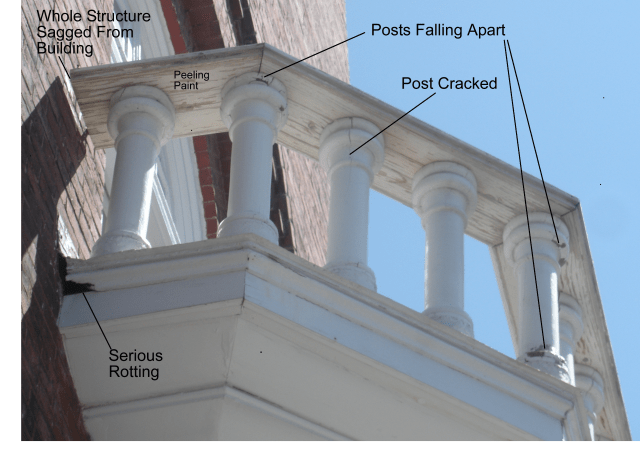
Next time you’re in front of Brewster Hall, take a closer look at that Romeo and Juliet balcony on the front of the clock tower. You’ll recall that the Friends had it completely removed and professionally rebuilt five years ago. It took all summer and I have to say it looked pretty good when completed. Today it’s sagging, pealing and rotting. Think four million will buy us another hundred years? Think again.

The only real question before us is whether to go all-in on a 19th century money-pit or hold out for the choice to build practical infrastructure and move forward into the 21st century.

Posted in Brewster Hall/Town Office, Town Politics | 10 Comments

Big win for Wolfeboro in RIB lawsuit

Today, the court finally ruled on Wright-Pierce’s motion to reconsider the court’s refusal to extend the period to supplement expert testimony. That’s a mouthful, but what it boils down to is that Wright Pierce’s experts, Haley and Aldrich, inc., had developed a remedial plan for the RIB site that they claimed could make Wolfeboro whole by restoring the site to the originally permitted capacity.  The court has struck the plan from the record and will not allow Wright Pierce to introduce any expert testimony about it.

That’s a big deal for the Wolfeboro team, and may well represent a turning point in the disposition of the defense and open the door for a large settlement.

In reading the order, it looks as though Wright Pierce’s attorneys have been incredibly inept at advancing their case.  In the court’s explanation, it cites repeated instances of where their motions and arguments were filed too late or as new arguments where only rebuttals are allowed.

The court also takes issue with the fact that Wright Pierce didn’t produce the remediation plan until five months after the deadline for supplementation of expert testimony.

At this point, Wolfeboro has said they will not mediate, and wants a large settlement of everything the town has spent.  I think that’s somewhere in the $7 million range.  Absent the fraud and treble-damage amendment, Wright-Pierce would have had nothing to lose but attorney’s fees in going to trial over that.  At this point, it’s hard to say exactly what will happen.  If I were Wright Pierce or their insurance company, I’d look at this ruling and wonder if I’m getting my money’s worth from my attorneys.

Posted in RIB Lawsuit | Comments Off on Big win for Wolfeboro in RIB lawsuit

Another big RIB lawsuit moment

The last big event was the motion to amend the lawsuit to include allegations of fraud.  This was a big deal for Wolfeboro because it upped the ante considerably by opening the door for treble damages.  With a claim of $10 million in damages, the theoretical potential is now $30 million.  Whether that’s realistic, or WP can pay it, or whether it’s enough to cause the suit to languish in an eternity of appeals are other questions, but the bottom line is that it probably was intended to scare WP into settling on Wolfeboro’s terms.

It doesn’t appear to have had that effect.  As part of the order allowing the amended complaint, the judge said that additional time for discovery may be necessary and that the parties can ask for it.  In their objection to the amendment, WP had said that additional expert testimony would be needed to defend, and the order says they can ask for that too before the end of the discovery period.  WP did ask for it – just before the end of the discovery period.  The judge allowed the discovery but not the new expert testimony.  And that’s the big issue on the table now.

The town maintains that the RIB site is completely failed, and must be replaced with some alternate effluent disposal capability.  That justifies asking for everything that we have ever spent on it.  WP maintains that the site can be repaired, and even says it can handle the originally permitted 600,000 gallons per day.  That’s a pretty big difference of opinion, and opinion is what the expert witnesses bring to the table.  WP’s experts, Haley and Aldrich, Inc., in their original testimony, opined that the site could be fixed.  Wolfeboro and their experts have said that it can’t be fixed, and have said that the approach suggested by WP cannot be permitted.

So WP had their experts produce a more detailed description of their proposed Remediation Plan  and convinced Wolfeboro to bring it to NHDES for review.  Big surprise, NHDES, in a letter,  said that the slope stabilization part of the plan was OK by them, and recommended that it be done.

They did however, say that impacts to the wetlands were an ongoing problem and that any solution had to address that as well.  So WP hired a wetlands expert to take a look,  Unfortunately, Wolfeboro won’t allow him to look at the site.  Not to be deterred, WP had him assess the portion of the impacted wetlands in Tuftonboro, and examine photographs and topographic maps of the Wolfeboro side.  He produced a report in which he offers the opinion that the channelization issues in the wetlands can be mitigated and potentially reversed by felling trees to “rough up” the terrain.  He says this is a common practice called “chop and drop” used to control erosion and has been permitted in other wetlands in NH and elsewhere.

According to WP’s latest motion for leave to file reply to objection  of their motion to extend the time to supplement expert testimony, Wolfeboro doesn’t want any part of it.  They also say that Wolfeboro won’t consider mediation.

I have no idea if what WP is proposing would actually work, but it looks as if they are determined to pursue it.  NHDES seems to at least take their approach seriously, although they offer no opinion on any potential capacity impact.  More importantly, they say that while initial permitting is based on expected performance, ongoing permitting will be based on actual performance.

So Wolfeboro is not interested in repairing the site, and is doing everything they can to keep that prospect out of any trial by resisting the inclusion of additional expert testimony.  Presumably, the town would take the proceeds of any award and use it to pursue some alternate effluent disposal strategy.  But the reality is that even at current levels, the RIB site, along with seasonal spray field operation, is just about adequate for our needs.  It’s not inconceivable that the town would get a new engineer after the trial and actually implement some of these “fixes” to the RIB site to allow 300,000 gpd or more and just live with it.

So it all hinges on whether the judge grants this motion to effectively allow WP to make their plan to fix the site part of their defense.  My guess is that it will not be allowed, and that will become the basis of an appeal.  Once again, the lawyers can’t lose.

Posted in RIB Lawsuit | Comments Off on Another big RIB lawsuit moment

Mr. Murray’s ambush

All the ducks were in a row at the BOS public hearing Wednesday.  All the active members of the Friends were there with well rehearsed and choreographed presentations.  One talked about the tourist expectations, another their version of past referendums, yet another the community building potential.  An altogether impressive effort.

After awhile, I started to get the theme, but was puzzled why Roger Murray, yellow lawyer pad in hand, hadn’t spoken.  I found out after I had my say at the hearing.

His job was to attack me.  He launched into it pretty aggressively.  Right away stating that I should know everything that’s going on in town because I had made “countless”  right to know requests.   There were eleven in the past year.  I have to wonder why it is that he is kept apprised of my right to know requests.

He launched into the accusation that he had asked me if there was anything they could do to gain my support and according to him, I gave the stupid response “I don’t know”.

In the summer of 2010, Mr. Murray contacted me to ask if I would meet with Mr. Grosvenor of NCA architects to discuss my concerns about energy efficiency of Brewster Hall.  I readily agreed and we left it that he would arrange it at Mr. Grosvenor’s convenience the next time he came to town.

Weeks turned to months, the Friends announced their gift of new plans for Brewster Hall (this was the first time in 2010).  I got another call from Roger.  “I’ve got Mr. Grosvenor here and we wanted to get that meeting going”.  I told them that I thought it was kind of late in the process to incorporate the kind of energy saving features that I had in mind.  Nevertheless, they insisted that I should meet with Mr. Grosvenor.  At that time Mr. Murray asked me if there was anything they could do to gain my support.  I believe I honestly replied “I don’t know”.

I didn’t know the details of their plans, I didn’t know what they were willing to do, and I didn’t know what their budget would allow, in short, it was very late in the process and I hadn’t been involved.  At the end of the phone conversation, I agreed to meet with Mr. Grosvenor at his earliest convenience.  Neither he or Mr. Murray ever followed up.

Roger says he heard I wasn’t satisfied with the Building Science report that was produced that year.  Earlier, I had pushed to have the town adopt a set of recommendations contained in a white paper from Building Science that detailed how old masonry buildings could be made very energy efficient.  The Friends are not interested in those methods because it compromises the antique plaster and the historic windows that they would rebuild rather than replace.  The Building Science report that the town paid for (the one I brought them was free), described what minimum measures can be taken if they insist on keeping the building original.  I told Mrs Murray that I would prefer the town adopt the original recommendations, and that at that time, the new recommendations were never actually incorporated into any plans, so it was hard to say what I thought of them.  As far as I know, in the three years since the report was produced, none of the recommendations have been incorporated into any actual building plans.  They are still just talking points.

Bottom line, all of these criticisms were used to try to portray me as someone who is unreasonable and couldn’t be satisfied despite their extraordinary efforts.

They all seem to have lost sight of the fact that I did support that 2011 restoration warrant.  At the deliberative session I think what I said was that if you want to fix this building, this is as good as it gets, and you ought to vote for it.  Later that night, I said simply that I support the article.  The following year, I got up at the deliberative session and spoke in favor of the $200,000 repair warrant article.

Personal attacks go with the territory, especially when they have no legitimate counter to my criticism of their current plans.

Posted in Brewster Hall/Town Office, Town Politics | Comments Off on Mr. Murray’s ambush

Cumbaya at the BOS

Last night’s BOS meeting was dominated by the roll-out of the Friends’ plan to finally git ‘er done at Brewster Hall in the form of a public hearing that is required by law for bonded projects over $100K.  They started off with a nice speech by Joyce Davis, brought up Rob Houseman for the obligatory Power Point show, then launched into a series of testimonials from the core members of the Friends that exponded on the virtues past and present of the great building.

We heard about that magnificent bell that tolls in the night, how someone’s B&B guests repeatedly praise the Town Hall, and how some poor non-profit agencies will now be able have board meeting in the 300 seat great hall.  All very compelling.

Just when it was about to break out in song (That’s the Cumbaya part), I got up to be the party-pooper.  My problem with this is pretty well documented.  It goes back more than a year when Mrs. Murray steamrolled the notion of handing the whole authority for the future of the building over to the Friends.  I wrote about how bad that plan was at the time.

The fundamental issue isn’t their long sought restoration.  It’s about how Mrs. Murray and several other Selectmen have, for the second time, taken the responsibility and authority for determining what Wolfeboro will do with Brewster Hall and placed it in the hands of a private group to develop their exclusive idealistic notions of what the place should be.

They are ramrodding a superficial plan onto the ballot in order to get $4 million dollars which they claim is what this will cost.  They have produced no realistic set of actual plans and no actual cost estimate from any contractor.

We’ve been down this road before.  When given half million in 2007, they went hog-wild and produced the $7 million extravaganza that voters slapped down in big numbers.  Once burned, twice a fool.  Why would we give them $4 million now?  They have a terrible track record and have deliberately excluded the public from their program.

It’s a fact that these folks have the political strength to stop any effort to move town offices out of Brewster Hall.  And that’s fine.  I proposed that we adopt the Wakefield approach.  Turn the auditorium over to the Friends to fix up with their private money, and leave the office renovation to the town through annual capital improvement appropriations.  No borrowing, and no multi-million dollar nest egg that the Friends can go wild on.

The Selectmen voted 3-2 to recommend the Friends’ plan.  Dave Senecal and Brad Harriman said they would prefer to continue to renovate incrementally without borrowing.

Dave Bowers actually said he liked paying taxes (watch it on video, he did precede it by saying this is going to come out wrong) and that he thought we should take advantage of current low interest rates.  Isn’t that the way in America, it’s not about how much you spend, it’s about how much you can save.

In her typical fashion Linda Murray went through 25 years of history as she sees it to justify staying in Brewster Hall.  She says the Friends have some 350 or so people involved in their pledge activity.

Their going to need it.  To pass, they’ll need well over 1,000 votes.

Posted in Brewster Hall/Town Office, Town Politics | Comments Off on Cumbaya at the BOS

Changes at Metrocast

Update Dec 18, 2013.  Things are being switched around, but it’s hard to keep up.  I recently got the two free DTAs from Metrocast and they work fine on my older analog sets.  The channel numbers are automatically mapped.

For my HD TV with the QAM tuner, I’ve given up on trying to keep up with the channel changes.  When I picked up the free DTAs, I got a HD DTA for $4/month.  Works great and maps all the channels according to the guide.  It tunes and unscrambles the HD channels on the 7xx numbers, which otherwise would not be available in HD.  All in all, $4 is not a bad price to add HD, but I am looking into some kind of economical device that will accept a cable card.

-*-*-*-*-*-*-*-*

We all received notification from Metrocast that they were going to migrate to a mostly digital broadcast.  If you have an older TV set that is directly connected without a cable box, you will need a digital converter.  Metrocast will provide up to two converters free to each subscriber, and charges only $2 bucks/month for extras.

Subscribers with TV’s connected through cable boxes or DVRs  probably won’t notice any difference.  Those devices will be reprogrammed to use the new channels as changes are made.

Right now, Metrocast seems to have begun transmitting the digital SD signals on the QAM-5 channels.  So for instance channel 4 is analog, 4-1 (4.1) is HD and 4-5 is digital SD. Here’s how the basic channels seem to be broadcast today:

Analog Digital HD Digital SD
2 WGBH 2 2-1 2-5
3 NECN 3 3-1 3-5
4 WBZ 4 4-1 4-5
5 WCVB 5 5-1 5-5
6 WFXT 6 25-1 25-5
7 WHDH 7 7-1 7-5
8 Guide 8 8-5
9 WMUR 9 9-1 9-5
10 WLVI 10
11 WENH 11 11-1 11-5
12 Metrocast Ad 12 who cares?
13 WGME 13 13-1 13-5
14 N/A
15 WCSH 15 6-1 6-5
16 HSN 16 16-5
17 Not Available
18 WSBK 18 38-1 38-5
19 C-Span2 19 88-21
20 COZI 20 62-1 62-5
21 ION 21 21-1 21-5
22 C-SPAN 22 22-5
23 QVC 23 23-5
24 Wolfeboro 24 24 99-1
25 Wolfeboro 25 25 99-2
26 Wolfeboro 26 26 99-3
TBS formerly 14 34-5

There doesn’t seem to be any HD channels readily available for extended basic.  They must be scrambled.  The SD channels continue to be available, though somewhat moved around, and if you have a relatively small high-def TV, the clarity of the digital channel is probably fine.  On the other hand, if you have a large TV, you may want to pop the extra bucks to go digital with HD, a substantial increase that also requires cable boxes to get the HD.

I don’t know what is going to happen on Jan 1, but my hope is that they will start broadcasting the base channels in digital, so if I tune say 52 (Comedy Central), I will get the clear digital version and not have to go to 75-5 as is the case now.

I’ll figure it out and post it sometime in January, meanwhile I have to get some of those free DTAs for my non QAM tvs.

Posted in Brewster Hall/Town Office | Comments Off on Changes at Metrocast

Winepesaukee Drive a dead end

At least for now.  At the last BOS meeting, we got an update on the effort to fix the road and get it accepted as a town road.

The current residents of this 20 something year old development had petitioned the town to lay out their private road, repair it, and get it accepted as a town road.  They were asking that the cost be bonded by the town to be repaid by betterment assessments on the 42 or so lots in the subdivision.  The Selectmen voted to do so, contingent on not receiving a petition against the action within the statutory ten day period.

Wednesday night the town said it had indeed received such a petition from the developer and owner of 22 existing unsold lots.  There was some discussion as to whether the developer holds a single interest or 22 interests, as there is some ambiguity in the literal reading of the statute, but the town’s attorney has advised that 22 is the correct interpretation.

It was then disclosed that the developer has subsequently submitted a new petition to lay out the road, but without passing the cost on to the property owners through betterment assessments.  In other words, asking that the town as a whole fix what is currently a private road.  The Selectmen voted to not act on that petition.  I suspect we will be hearing more on that.

Residents of the development say the developer is currently responsible for maintenance of the road, and have sued B&H Development.

The road is in terrible condition.  There are large bumps caused by frost heaved boulders under the surface, and it is difficult if not impossible to plow effectively.  I won’t go there again unless I’m driving my Jeep.

You have to have some sympathy for the homeowners who are affected by this deteriorating situation, and it has been pointed out that the town bears some responsibility in that our approval of the subdivision and return of the construction bond was a failure on our part to protect the interests of what became taxable property owners in town.  But the other side of the coin is that the developer would be handed a windfall of substantial increase in value of his remaining lots if the town fixed the road at it’s own expense.

We haven’t heard the end of this story.


Posted in Town Politics | 2 Comments

Another side of the RIB story

Today, WP filed a new motion asking the court to reconsider it’s denial of their request to extend the deadline to supplement expert witness testimony.  The legal arguments for reconsideration and extending are obscure and based on case law establishing “just cause”.

Also, WP is asking the court to consider the fairness of allowing them to respond to the allegations of fraud that were allowed by the court this summer in their amended complaint, which WP noted was filed six months after the deadline for such filings.

At the heart of the matter, and the object of Wolfeboro’s objection, is WP’s intent to add the recently produced  H&A Remediation Plan  that was reviewed by NHDES and recommended for implementation.  WP contends that they also intend to introduce a modeling expert to refute Wolfeboro’s claims concerning the inadequacies of the original modeling that was used to support the initial design and permitted capacity of 600,000 gallons per day (gpd).

Near as I can interpret the remediation plan, it calls for covering the steeper failing slopes with a “geotechnical fabric” covered with up to three feet of rip-rap, which are large stones.  The idea is that the slopes will still ooze some groundwater, but that it will not cause erosion and migration of soils.

The NHDES letter seems to indicate some disagreement between NHDES and WP as to the ultimate effectiveness of this approach in increasing the site capacity.  My impression is that WP considers this seepage OK in that it is not a “point source discharge”, while NHDES seems to believe it is a bottom line test.  In other words, they don’t care how the water is discharged, it cannot reach the wetlands and nineteen mile brook as surface water.

WP has engaged a wetlands expert and wants to have them evaluate the situation.  Wolfeboro is blocking them from access to the site.  WP’s initial motion to the court to compel Wolfeboro to allow the site visit was withdrawn, according to Dave Ford as a result of threats from Wolfeboro.  That motion was filed again last week.

At this point, the position of the two sides are diverging more and more.  Wolfeboro increased the stakes with their allegations of fraud, and WP in turn is minimizing the problem by claiming that full capacity can be achieved for something in the $1-2 million range.  Both sides are stretching the limits of credibility, but because the stakes are now so high, there is little likelihood that either will agree to a settlement.

So our fate may be decided by a dozen of so ordinary citizens, purposely chosen from the population by jury specialists to understand as little as possible about the actual situation.  You can’t make this stuff up.

Posted in RIB Lawsuit, Town Politics | Comments Off on Another side of the RIB story

SRO at the Selectman’s Meeting

They were packin’ em’ in at the library last night, and the meeting was delayed at the start as the Selectmen were meeting elsewhere with their town-council before the meeting. The big crowd was caused by a confluence of two large issues that are destined to dominate the annual town meeting this year.

First up was a public hearing on a petition by residents of Winnipesaukee Drive to have their private road rebuilt and accepted as a town road.  The town has estimated the cost to be about $1.1 million.  The road is a mile long.

The private subdivision was approved in the late 1990’s.  It was said that the developer made a commitment to purchasers to maintain the road until more than half of the lots are sold.  It was also stated that 24 of 48 have been sold, 46 of them are in Wolfeboro, the others are in Alton. The road is a wreck. Residents have petitioned to have the town finance rebuilding the road with a bond issue, and pass the cost back to the individual lot owners through a betterment assessment over ten years.

Sounds straightforward.  But towards the end, the attorney for the developer got up and spoke.  He said that his client is in favor of having the road rebuilt, but there are options other than building to town specs.  One, that was  later described by a resident as resurfacing of only part of the road,  would cost as little as $90,000.

The big bomb was when the attorney suggested that the town should consider rebuilding the road at the taxpayer’s expense.  He cited a court case where a town had originally planned to do a  betterment assessment, but was later sued and directed to remove the assessments.

It’s a beauty.  The Selectmen decided to go forward with the full reconstruction and betterment assessment, subject to the statutory opportunity for a majority of owners to object within ten days.  If the town approves the bond issue, we could end up eating the cost with a lawsuit from the developer.

There was a brief sideshow when one of the Selectmen accused the developer’s attorney of having a conflict of interest, in his capacity as the Town Moderator, should he sue the town.  The attorney responded by saying that he saw no conflict and that hardly a year goes by where he doesn’t have occasion to sue the town for something.

The other big issue was the conference with the Friends of Town Hall.  They announced that they have pledges for about $720,000 from 160 donors, and are committed to keeping up their efforts.

That was followed by the Town Planner with a brief slideshow presentation of a plan to renovate the first floor, part of the basement, and the second floor hall.  No questions were solicited from the audience.  Of course by that time most of the audience were members of the Friends and it’s their plan.

There was no discussion of any cost estimates having been developed, or what state any actual plans might be in.  It’s all very hush-hush.

Nevertheless, there was great enthusiasm expressed by several of the Selectmen who couldn’t wait to vote and approve…..  something.  The proposed warrant article has to be returned to Town Council for review because they changed the wording and added some bolding of statements.  In the end they voted to move all four of the bonded articles to public hearing.

Posted in Brewster Hall/Town Office, Town Politics | Comments Off on SRO at the Selectman’s Meeting

Tax Rate posted – up 1.5%

The Department of Revenue Administration posted Wolfeboro’s 2013 tax rate today.  $12.83 – up 1.5% from last year’s $12.64.

Here’s the breakdown:

Town School State Ed County Total
2012 4.71 4.48 2.40 1.05 $12.64
2013 4.73 4.53 2.46 1.11 $12.83
Change 0.42% 1.12% 2.50% 5.71% 1.50%

As you can see, the town rate increased only 2 cents, the local school district 5 cents, while State Ed and County both each increased 6 cents.

Overall property valuations decrease about $8.5 million or…  0.42%.  If valuations had stayed up, the town rate would not have increased at all.  So in addition to the legal fees and refunds that resulted from the valuation lawsuit, the abatement has have driven up the tax rate.

Posted in Town Politics | 7 Comments

Yet another crappy building

I’ve been keeping my nose out of the new Public Works building that is going up to replace the barn that burned down last winter.  Mostly, I’m just disgusted with the bunker mentality that the town has with regard to anyone questioning their building decisions.

But today, I was driving back from the dump and saw that they were pouring the slab floor of the building.  I stopped and took a look.  Here’s a picture of the prepared site:

IMG_0175

You can see that it has some insulation and radiant heating tubes.  Sounds great, but there are a few serious problems:

  • The radiant tubes are at the bottom of the six inch slab.  In other words, the tubes aren’t so much in the slab as under it.  Any heat delivered through the tubes must pass through six inches of concrete to reach the interior of the building.  I’ve read several accounts of radiant floor systems that have been abandoned (installed another kind of heat) because the tubes were installed this way.  There is some suspicion that the radiant floor in the Pop-Whalen lobby was poured this way.  That relatively small building burns more than 2,000 gallons of oil per year and barely maintains the desired temperature.
  • The insulation under the floor is only 1″ thick.  This is criminal, especially with the tubes right there against it.  Guidelines for heated slabs in our climate zone call for at least three inches, typically four.  There is a school of thought that “heat rises” so insulation is not necessary.  That is wrong.  Hot air rises, but heat conducts from hot to cold with no regard for direction.  In this case, the ground is 50 degrees, the tubes will probably need to be 120 degrees or more.  A large portion of the heat supplied to the tubes will simply go into the ground.
  • There is no vapor barrier in the exposed spaces.  The insulation board is taped and will provide some vapor resistance, though at only one inch thick not as much as a real membrane.  But look at the huge spaces that are not insulated and have no vapor barrier.  That’s just slipshod work.

This system as installed, if it works at all, will cost a small fortune to operate.  Even with wood pellets for a fuel.  Adding more insulation would have paid for itself in the first one-two years.  Raising the tubes to the standard two inches from the surface would have been a little more work, but would have resulted in a system that actually works well to heat the space.

Here’s an analogy:  Say you wanted to heat a basement that has six inch concrete walls.  So you dig around the house and put tubing against the outside wall below grade.  Then you cover that tubing with an inch of foam board and back fill.  You then you connect the tubes to your boiler and try to heat up your foundation walls to heat your basement.  Can you think of a better way to do it?  Do you think it might work better if the tubes were imbedded near the inside of the foundation?  How about if there was more insulation outside?

The pitch was that we would save money by having our Public Works director be the general contractor  for this job.  Instead we will end up paying year after year with inflated fuel bills, and probably have a problem keeping the place warm enough.

IMG_0177

Posted in Home Energy, Town Politics | 1 Comment

Back to basics

I see that the Grunter has published the URL for this blog as part of their coverage of the last Selectman’s meeting.  For anyone looking to read the arbitration/mediation mia-culpa, you can find it here.  But hopefully there will be a few new readers finding their way here, and rather than look at the sideshow, maybe you want to take a few minutes to catch up on what the lawsuit is all about.

The best place to start is by listening to Dave Ford’s explanation at a Selectmen’s meeting on April 17th of this year. Click here, and then either wait for Ethan to finish or space in 6:30 to get to Dave Ford.  If you are interested in forming an opinion about this lawsuit, you owe it to yourself to listen to Dave’s side of this.

At that time, we had spent $400,000 and had a war chest with another $300,000 left in it.  The town expected to go to trial at the end of the year, and thought they had plenty of money to see it through to a conclusion.

Then, a few weeks later, Wolfeboro asked to file an amended complaint to include allegations of fraud and to request treble damages.  That was like starting a whole new lawsuit.  The issues in the original suit were pretty straightforward.  Now the town was saying that the WP engineers and their consultants knew that the thing wouldn’t work as far back as 2007, and hid that fact from the town so that they could collect more fees, and so they could brag about building the largest rib in the country.

They lost me there. I can’t feature being a supporter of that tactic. You can click “RIB Lawsuit” at the top of the right margin and get all of the posts in this blog relating to the lawsuit.  It reads bottom (oldest) to top.  You can wade through my obviously biased commentary and read the actual court filings for yourself.  They are surprisingly easy to read and follow.

Posted in RIB Lawsuit | 1 Comment

The object of the objection

So today Wolfeboro filed their objection  to WP’s motion to continue and extend deadlines.  They’re not opposed to extending the deadlines for discovery and the trial, after all, it’s critical that some of this work be moved to the next fiscal year where we will have another half-million for their fees. Continue reading

Posted in RIB Lawsuit | Comments Off on The object of the objection